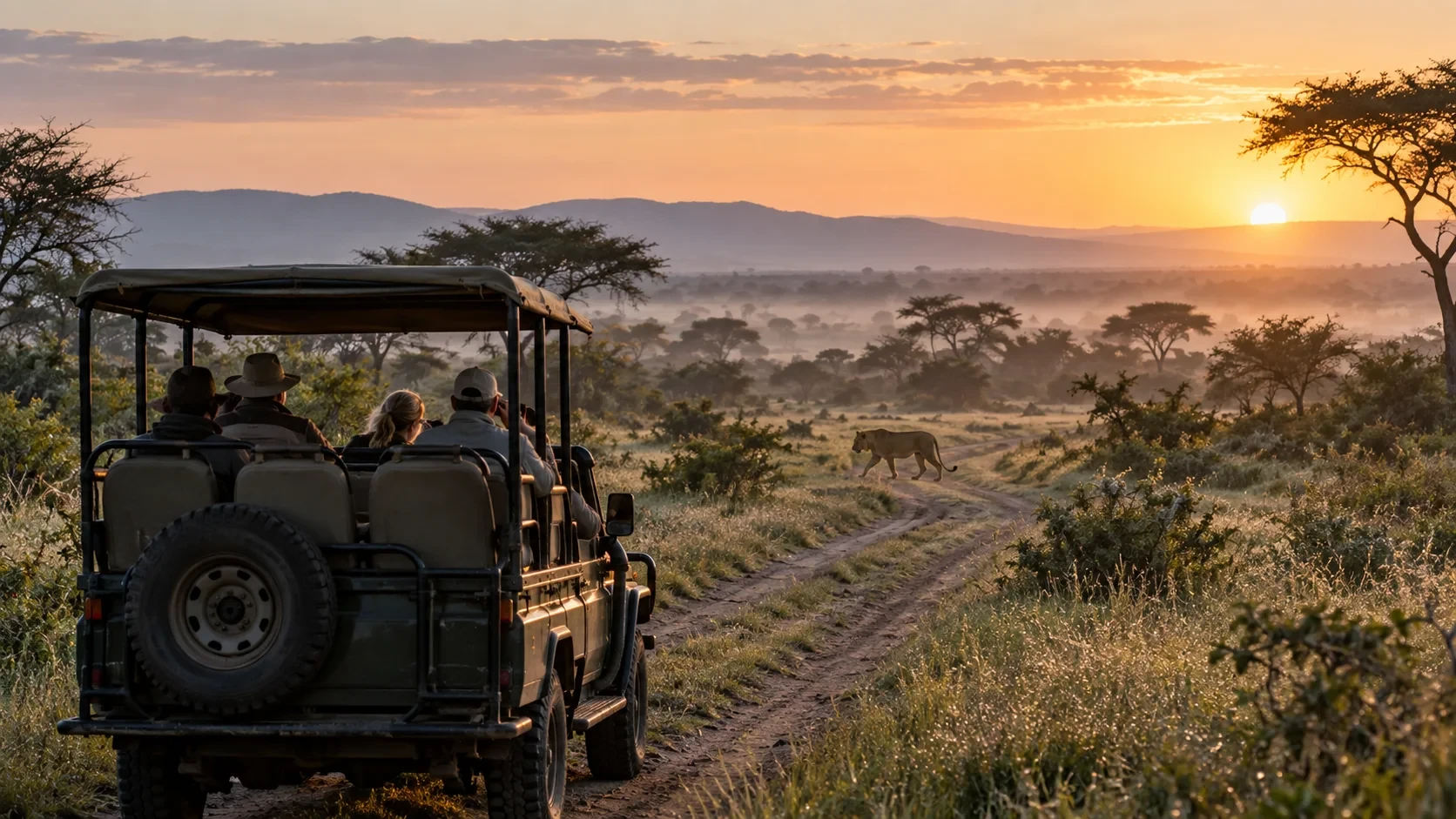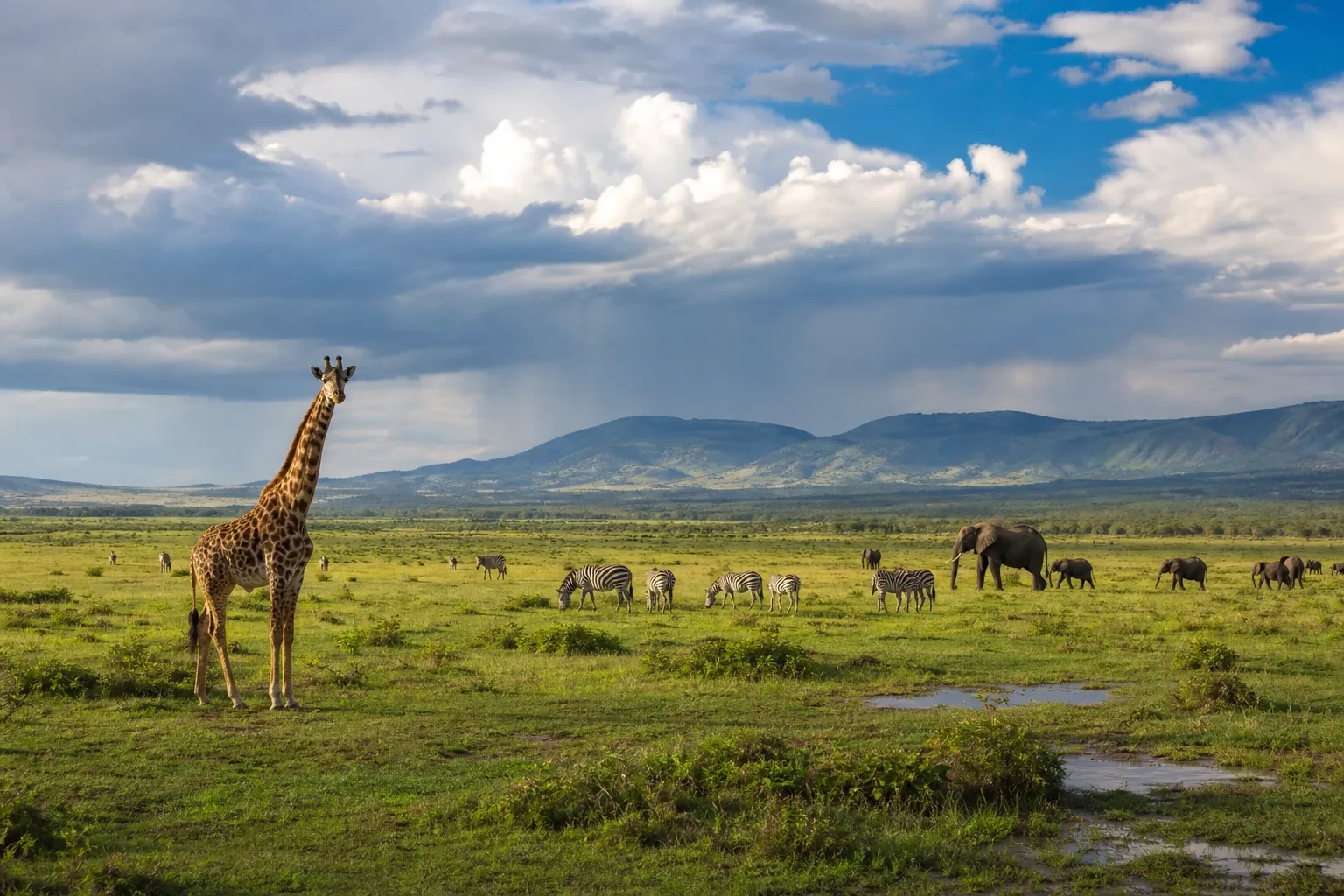
What To Pack On Safari: The Complete Safari Packing List (2026)
A safari packing list must cover neutral-toned clothing, layering pieces, sun and insect protection, quality optics, camera gear, preventative pharmaceuticals, and key travel documents — all within the strict 12–15kg soft-bag weight limits imposed by bush aircraft operators. Pack deliberately, keep it light, and every item earns its place.
Essential Safari Clothing & Footwear
Safari clothing performs three jobs simultaneously: temperature regulation, insect deterrence, and wildlife camouflage. Mornings and evenings on the African savannah drop sharply — sometimes below 10°C in winter — while midday temperatures in East Africa regularly exceed 35°C. Layering is non-negotiable.
Colour Rules That Actually Matter on Safari
Getting your colour palette right directly affects your wildlife experience and personal safety.
- Neutral tones — khaki, beige, olive, tan, stone, and sand grey — blend with the bush and avoid alarming animals during game drives
- Black and dark blue attract tsetse flies, which carry African sleeping sickness and deliver a genuinely painful bite
- Bright colours and white make you visually conspicuous to wildlife and show dust within minutes on dirt tracks
- Camouflage patterns are illegal for civilians in Zimbabwe, Zambia, Kenya, and several other African nations — this rule extends to caps, shorts, and accessories, not just full outfits
A 2023 wildlife behaviour study conducted at Kruger National Park found that open-vehicle safari groups wearing high-contrast colours experienced a measurable increase in flight responses from large mammals compared to groups wearing neutral tones — reinforcing decades of field guide advice. The colour principle applies to hats, bags, and accessories, not just shirts.
Tops, Bottoms & Layering Pieces
I always build a safari wardrobe around long-sleeved, moisture-wicking or lightweight cotton shirts and full-length trousers. Zip-off convertible trousers are particularly practical — they adapt from cold dawn drives to hot afternoon bush walks without requiring a full outfit change. Shirts with ventilation panels and collared long-sleeve options earn their place in any bag. Pack a lightweight fleece or windbreaker for early-morning game drives. If heading to the Okavango Delta in June or the Maasai Mara in July, temperatures before sunrise can catch visitors completely off guard. A packable down gilet under a windproof shell changes everything — I know this from direct experience on the back of a Land Cruiser in the Linyanti Concession in July, where a thin fleece alone simply did not cut it. Clothing essentials to pack:
- 3–4 lightweight, neutral-coloured shirts (khaki, olive, beige, grey)
- 2 pairs of quick-dry safari trousers or convertible zip-offs
- 1 pair of shorts for camp use and warm-weather destinations
- Lightweight fleece or down jacket — mornings and evenings drop sharply
- Rain jacket — required for the green season and highland destinations
- Moisture-wicking underwear and wool-blend socks
- Smart-casual dinner outfit — required for evenings at upmarket lodge properties
- Sarong — lightweight, multi-use: beach cover, blanket, privacy screen
- Swimwear — most mid-range and luxury lodges maintain a pool
Seasonal priorities at a glance:
| Item | Dry Season (May–Oct) | Green/Wet Season (Nov–Apr) |
|---|---|---|
| Fleece / Insulated Jacket | High priority | Low priority |
| Packable Rain Jacket | Optional | High priority |
| Zip-off Trousers | High priority | High priority |
| Swimsuit | High priority | High priority |
| Base Layer / Long Underwear | High priority | Not needed |
| Wide-brimmed Hat | High priority | High priority |
| Sandals | High priority | Optional |
| Smart-casual Dinner Outfit | High priority | High priority |
Cold Weather Safari Destinations: When You Need Serious Warmth
Several of Africa’s premier wildlife destinations drop to genuinely cold temperatures during the Southern Hemisphere winter. Hwange National Park in Zimbabwe, the Okavango Delta and Linyanti Concession in Botswana, and Kruger National Park in South Africa all experience near-freezing mornings between June and August. Factor in wind-chill on an open game-drive vehicle travelling at speed, and a temperature that feels manageable on the ground becomes biting on the vehicle. For these destinations, pack:
- Thermal gloves — thin liner gloves that fit under thicker shells
- Knitted beanie or fleece hat — covers ears on early-morning drives
- Heavyweight fleece or down jacket — your primary warmth layer
- Merino wool base layer — regulates temperature and resists odour between washes
- Windproof shell jacket — blocks wind-chill without adding significant bulk
A reliable resource for East African conditions is the Rough Guides Africa travel advice page covering safari clothing and packing by season, which breaks conditions down by country and month.
Safari Footwear
Three footwear types handle every safari activity:
| Activity | Recommended Footwear | Key Attribute |
|---|---|---|
| Game drives (vehicle) | Comfortable trail runners / trainers | Ankle support, easy on/off |
| Bush walks | Waterproof hiking boots | Ankle protection, grip |
| Camp & lodge | Lightweight sandals or slip-ons | Breathable, packable |
| Gorilla trekking | Mid-height waterproof hiking boot | Mud-grip sole, gaiter compatibility |
Closed-toe walking shoes or trail runners cover the vast majority of safari activities, including standard game drives and short nature walks. Pack heavy hiking boots only if your itinerary includes extended bush walking or gorilla trekking in Rwanda or Uganda. I learned this the hard way on a walking safari in Zambia — flip-flops near the waterhole at dusk is a bad call. Add sandals for lodge downtime, and swimwear for midday swims between game drives. Choosing the right safari clothing for African game reserves — particularly neutral colours and lightweight layering systems — directly affects both comfort and wildlife encounter quality.
Safari Gear & Optics
Binoculars — the Most Underrated Safari Item
Binoculars are, in my experience, the single most overlooked piece of safari kit. Visitors spend thousands on travel and then watch a leopard at 400 metres through squinted eyes. A good pair transforms a distant brown shape into a leopard draped over a branch. Choose a magnification of 8×42 or 10×42 — this range balances field of view with light-gathering performance at dusk and dawn when big cats are most active. Anything above 10× becomes shaky in a moving vehicle. A wide field of view (at least 6.5° at 8× magnification) allows guides and guests to track fast-moving predators like cheetahs across open grassland — a capability that directly affects sighting success rates.
| Binocular Spec | Recommended Use | Magnification | Field of View |
|---|---|---|---|
| 8×42 | Open savannah, general use | 8x | Wide |
| 10×42 | Dense bush, long range | 10x | Narrower |
| 10×50 | Low-light dawn and dusk drives | 10x | Wide |
| 12×50 | Advanced birding and distance | 12x | Narrow |
Brands consistently rated for durability in dusty, high-UV environments include Vortex Viper HD, Nikon Monarch 7, and Swarovski EL — all carry full lifetime warranties. First-time travellers who skip binoculars consistently report missing key sightings, especially on vast open plains like the Serengeti and Masai Mara where animals are frequently 200–500 metres away.
Camera & Accessories
A quality pair of binoculars used during a three-hour game drive will typically reveal 40–60% more wildlife sightings than the naked eye, particularly birds and distant predators. A camera with a zoom lens of at least 200–300mm is the practical minimum for sharp wildlife photography from a game vehicle — phone cameras simply don’t reach across 80 metres of open grass to frame a leopard in a fig tree. Africa produces extraordinary photographic conditions: golden hour lasts longer near the equator, and the light between 06:00–09:00 and 16:00–18:00 is world-class. Wildlife photography on African safari consistently ranks among the most rewarding travel photography experiences for both amateur and professional photographers. Camera and optics kit to pack:
- DSLR or mirrorless camera body (Sony A7 series, Nikon Z, or Canon R systems all handle dust and heat well)
- Telephoto zoom lens — 100–400mm or 200–600mm covers the full range of safari distances
- Backup camera body or high-quality smartphone with optical zoom
- Extra memory cards — minimum 128GB total capacity; bring two to guard against card failure
- At least two spare batteries and a multi-battery charger — remote lodges often have limited charging windows
- Bean bag or window mount — replaces a tripod in a game drive vehicle and produces sharper images
- Dust-proof camera bag or dry sack to protect equipment on open-vehicle drives
The Serengeti hosts the largest overland wildlife migration on Earth — approximately 1.5 million wildebeest and 250,000 zebra move through annually. Telephoto lenses of at least 300mm are needed to photograph the river crossings properly from standard game-drive distances.
Sun & Dust Protection
- Wide-brimmed hat with a chin strap — essential on open-sided Land Cruisers at speed, which will take a standard brim hat clean off your head
- Polarised sunglasses to cut glare off water sources and open plains, and protect eyes from dust
- Buff or lightweight scarf to wrap over the nose and mouth on dusty tracks
- Microfibre cloth — cleans dust off camera lenses, binoculars, and sunglasses without scratching coatings; carry two
 Torch and Lighting Gear
Bush camps frequently cut generator power by 22:00. A headlamp with a red-light mode is the smarter choice over a torch — it preserves night vision and leaves both hands free when walking between tents and the main lodge in the dark. I switched to a headlamp-first approach after losing a handheld torch down a riverbank on a Zambian walking safari.
| Torch Type | Best Use Case | Key Attribute |
|---|---|---|
| Rechargeable headlamp | Night walks, writing journals, tent use | Hands-free operation |
| Compact LED torch | Emergency backup, star-gazing | Lightweight, pocket-sized |
| Pencil torch | Star map reading, fine detail work | Minimal light footprint |
| Solar-charged lantern | Extended camp stays | No battery dependency |
Most established safari camps will provide a torch or escort guests back to their tents after dinner. Self-sufficiency still matters — remote fly-camps and mobile tented expeditions operate with minimal staff after dark, and your own light source makes the difference between confidence and anxiety. Pack a book or e-reader for airport delays and “Africa time” — the colloquial term for the relaxed, unpredictable scheduling that governs much of southern and east African travel. A travel journal is something I personally recommend above almost any other non-essential item. Safari days are dense with experience — lion kills, elephant charges, sunsets over the Chobe River — and memories blur quickly. Writing even 10 minutes of notes each evening builds a record you will return to for decades.
Tech & Electronics
Electronics on safari require as much planning as clothing. South Africa uses the Type M plug — three large round pins in a triangular pattern. Kenya and Tanzania use Type G (the same as the UK), and Botswana uses Type D and G. Confirm your destination’s socket type before you pack. Bring every charger you need and consider a multi-port USB charging hub to reduce the number of individual plugs you’re carrying. A portable battery pack rated at 20,000mAh or higher keeps cameras, phones, and GPS devices running through full-day drives. We’ve tested multiple options in the field, and those with USB-C Power Delivery ports charge camera batteries fastest. The Expert Africa safari preparation guide for UK travellers covers tech and electronics packing in detail, including camera recommendations for specific wildlife environments.
Health, Medical & Preventative Pharmaceuticals
Insect repellent and malaria prophylaxis are the two non-negotiables for health protection on any sub-Saharan African safari. The World Health Organization classifies Sub-Saharan Africa as a high malaria-transmission zone — prophylaxis must be prescribed before departure. Consult your GP at least 4–6 weeks prior to travel.
| Item | Specification | Notes |
|---|---|---|
| Insect repellent | DEET 30–50% concentration | Apply to all exposed skin at dusk |
| Sunscreen | SPF 50+ broad spectrum | Reapply every 90 minutes outdoors |
| Lip balm | SPF 15 minimum | Altitude increases UV exposure |
| Anti-malarial medication | As prescribed by GP or travel clinic | Start course before departure |
| Antihistamines | Non-drowsy formula | Insect bites, dust, and pollen exposure |
| Rehydration salts | Sachet format | Dehydration is common in dry season heat |
| Painkillers | Paracetamol and ibuprofen | Headaches from dust and altitude are frequent |
| Anti-diarrhoeal tablets | e.g., loperamide | Address stomach upsets fast in remote locations |
| Antacids | Standard formulation | Counter heartburn from unfamiliar bush camp food |
| Eye drops | Preservative-free | Soothe dusty, wind-irritated eyes after open drives |
| Personal prescriptions | 2-week buffer supply | Pharmacy access in remote areas is unreliable |
DEET concentration is what separates effective repellents from ineffective ones. Products below 20% DEET offer insufficient protection in high-mosquito environments like the Okavango Delta or Selous Game Reserve. I always carry two bottles: one standard DEET spray and a DEET-free citronella alternative for camp evenings when I am not actively in the bush. Permethrin spray for treating clothing and gear remains effective after multiple washes and deters ticks as well as mosquitoes. Carry all prescription medications in original pharmacy packaging — customs officials at several African airports require this — and always pack them in your carry-on, never in checked luggage that could go missing on connecting flights. Bring enough supply to cover your entire trip, plus a buffer of three to five days for delays. I’ve seen travellers arrive in Nairobi having forgotten their antimalarials entirely, scrambling to find replacements at inflated prices. For gorilla trekking in Rwanda — where Volcanoes National Park sits above 3,000m — or mountain safaris in Ethiopia, altitude sickness medication becomes relevant. Consult NHS Fit for Travel guidance on malaria prevention and travel health advice, which covers country-specific prophylaxis recommendations varying between East and Southern Africa. Avoid strong perfumes, colognes, or heavily scented body products. These attract insects and can deter skittish wildlife during bush walks. Most lodges supply soap, shampoo, and conditioner, so leave those at home and recover that precious weight allowance.
Safari Documents & Travel Finance
Your passport must carry at least six months’ validity beyond your return date — airlines and immigration officers at Nairobi, Johannesburg, and Lusaka airports actively enforce this rule. Carry physical and digital copies of every document; store digital copies on encrypted cloud storage, not just your phone. I always photograph every document before departure and email the folder to a trusted contact at home — it has saved clients significant stress when passports have gone missing in transit.
Vaccination Proof
Several East and West African nations mandate a Yellow Fever vaccination certificate for entry — particularly if you are travelling from or through a Yellow Fever endemic country. Tanzania, Kenya, and Uganda each publish their own entry requirements, which change periodically. Check entry requirements for Africa travel using FCDO travel advice pages before booking any vaccinations. Travel vaccinations required for sub-Saharan Africa typically include typhoid, hepatitis A, and a tetanus booster alongside yellow fever.
Cash for Tips and Small Purchases
US Dollars are the functional currency across most of East and Southern Africa for tipping, market purchases, and park fees where card machines fail. Carry notes printed after 2004 and in good physical condition — torn, marked, or older notes are routinely refused across East Africa, so request newer notes from your bank specifically before travelling. A reasonable daily tipping budget for guides and camp staff runs to USD $10–$20 per person.
Full Document Checklist
- Passport (6+ months validity)
- E-tickets and printed itinerary copies
- Travel insurance certificate with emergency medical evacuation cover
- Yellow Fever vaccination certificate (if required by destination)
- US Dollars in small denominations
- Visa documentation — Kenya now operates an e-Visa system for all visitors
- Emergency contact list: safari operator, camp names, nearest hospital or clinic, and your country’s embassy contact
Luggage Security at the Airport
Use combination locks to secure zip-pulls together on any bag that lacks its own locking mechanism. Wrap luggage straps around the full circumference of your suitcase and consider the shrink-wrapping services available at most major international airports — including Johannesburg O.R. Tambo and Nairobi Jomo Kenyatta — typically between £3–£8 per bag. The Association of European Airlines reported that luggage tampering and pilfering accounts for millions of pounds in passenger claims annually, with hub airports in transit-heavy regions presenting the highest risk. When advising clients booking multi-leg itineraries through Nairobi or Addis Ababa, we always recommend keeping valuables — passports, camera lenses, and medication — in carry-on luggage without exception.
Safari Luggage: Weight Limits & Bag Types
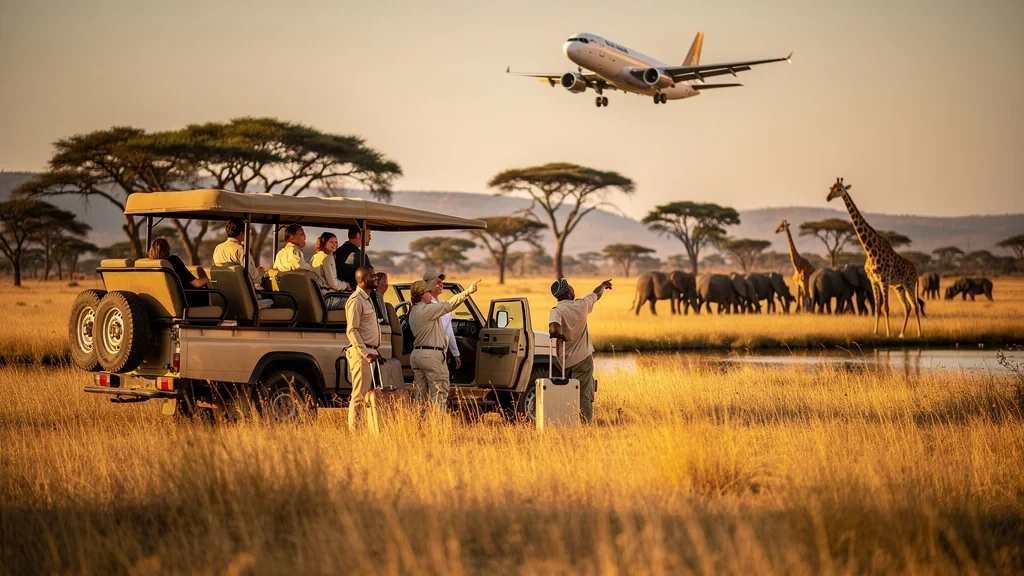
Bush aircraft — typically Cessna Caravans or similar light aircraft — impose strict baggage rules that differ from commercial airline allowances. Weight restrictions exist because small aircraft like Cessna 208 Caravans and Pilatus PC-12s are weight-and-balance critical — every kilogram is accounted for before departure. Exceeding limits means leaving bags behind at the departure airstrip.
| Flight Type | Typical Allowance | Bag Type Required |
|---|---|---|
| International economy (KQ, SA, Ethiopian) | 20–30kg checked | Hard or soft case |
| Internal scheduled flight (e.g. FlySafarilink) | 15kg | Soft bag recommended |
| Charter / bush flight (East Africa) | 12–15kg combined | Soft duffel only |
| Charter / bush flight (Southern Africa) | 10–12kg some operators | Soft duffel, no frames |
| Walking / mobile safari | 10–12kg max | Small soft bag or dry bag |
| Helicopter transfer | 7–10kg combined | Minimal soft bag |
I personally travel with a 40-litre soft-sided holdall for bush camps and a 20-litre soft daypack for in-cabin carry-on. This combination has never failed me across a dozen trips to sub-Saharan Africa. Operators including Wilderness Air, Air Kenya, and Safari Link enforce weight limits strictly — excess baggage is either stored at the airstrip hub or incurs a per-kilogram surcharge. Restrict hand luggage to one item only — this single rule simplifies every airport transfer and light aircraft boarding. That one carry-on must simultaneously accommodate: camera body and lenses (padded, protected), travel documents, prescription medication, optical aids, and one change of clothes for when hold luggage goes missing on multi-leg itineraries. Check the Civil Aviation Authority’s guidance on hand luggage and restricted items before every trip, as aircraft carry-on restrictions evolve regularly. The good news: nearly every safari camp and lodge of reasonable quality offers a same-day laundry service — often included in the accommodation rate. I pack for five days maximum and use the service on day three, which cuts luggage weight by roughly 40%. Three to four changes of clothes, rotated with laundry, comfortably covers a 10–14 day trip. The exception is mobile tented safaris — walking safaris or fly-camping expeditions where the camp moves with you. Laundry service is rarely available in these settings. Practical luggage strategies:
- Use a soft-sided duffel rather than a rigid suitcase — aircraft hold storage requires it
- Leave a secondary bag with your charter operator or airport hotel for items not needed on safari
- Confirm weight limits in writing with your tour operator before you pack
- Weigh your bag at home using a portable luggage scale — do not guess
What NOT To Pack on Safari
Knowing what to leave behind protects your weight allowance and your sanity.
- Hard-sided suitcases — bush aircraft cargo holds are designed for soft bags only; rigid cases are refused at most bush airstrips
- Drone equipment — most national parks in East and Southern Africa prohibit civilian drone flights without pre-authorised permits; attempting to fly one risks confiscation and expulsion from the reserve
- Bright, patterned, or white clothing — impractical in dusty environments, attracts insects, and can disturb wildlife
- Dark-coloured clothing — revisit the tsetse fly rule above
- Camouflage clothing — illegal for civilians in multiple countries, including Zimbabwe and Zambia; even a single patterned cap is sufficient to draw unwanted attention at a border crossing
- Heavy perfume or strong-scented products — disturbs wildlife and attracts insects
- Expensive jewellery — practical risk and security concern at remote camps and busy international airports; wear only a wedding band or simple stud earrings
- Heavy hardback books — download digital editions before you leave; a Kindle weighs a fraction and carries an entire library
- Excessive toiletries — most lodges supply quality soap, shampoo, and conditioner; biodegradable options are strongly preferred in conservation areas
- High heels or formal shoes — bush camps operate on uneven ground; closed-toe, ankle-supporting footwear wins every time
- Too many shoes — two pairs maximum covers everything
I have never missed expensive jewellery on a game drive. The distraction of a leopard draped across an acacia branch tends to make a Rolex feel entirely irrelevant. Trailfinders’ expert safari advice for UK travellers planning African itineraries covers additional destination-specific luggage guidance for Kenya, Tanzania, Botswana, and South Africa.
South Africa Safari Destinations: Matching the Right Park to Your Kit
South Africa’s major parks require slightly different kit priorities depending on terrain, climate, and activity type.
Private Reserves: Sabi Sands, Thornybush & MalaMala
Private reserves adjacent to Kruger — Sabi Sands, Thornybush, and MalaMala — permit off-road driving, meaning guides can follow animal tracks into thick bush. That access produces significantly closer sightings than standard park routes. MalaMala, which shares an unfenced boundary with Kruger’s western edge, has operated continuously as a private wildlife area since 1927 — one of the oldest private game reserves in South Africa — and its Big Five sighting rate remains among the highest on the continent. Lodges here operate at the five-star end: private plunge pools, ranger-led bush walks, and sundowners in the field. Luggage restrictions at these properties are real — soft-sided bags only, typically capped at 20kg, because most guests arrive via light aircraft from Johannesburg or Nelspruit.
Malaria-Free Safari Regions: Madikwe, Eastern Cape & Pilanesberg
Malaria-free reserves suit families travelling with young children, pregnant travellers, or anyone who cannot take antimalarial prophylaxis. These reserves remove the DEET and antimalarial medication considerations considerably, simplifying the packing list — though DEET-based insect repellent still applies for ticks and other biting insects year-round.
- Madikwe Game Reserve — wild dog packs and quality tented lodges in North West Province; 4 hours from Johannesburg
- Addo Elephant National Park — accessible from Port Elizabeth, home to over 600 individual elephants
- Shamwari Private Game Reserve — Garden Route access, Big Five present, conservation programmes open to guests
- Pilanesberg National Park — adjacent to Sun City, Big Five in a malaria-free zone 2 hours from Joburg
Bush & Beach Combos: Kruger Plus KwaZulu-Natal or Cape Town
Many operators structure itineraries pairing Greater Kruger game drives with Indian Ocean coastline in KwaZulu-Natal or a Cape Town extension. Practically, this means packing for two distinct environments: bush clothing in neutral tones and beach/city wear — which is exactly where people overpack and hit airline weight limits. Destination-specific kit requirements:
| Destination | Key Activity | Essential Extra Kit |
|---|---|---|
| Kruger National Park | Self-drive or guided Big Five game drives | Vehicle adaptor charger, full first aid kit |
| Addo Elephant Park (Eastern Cape) | Malaria-free family safari | No DEET required; standard SPF |
| Sabi Sand Private Reserve | Walking safaris with ranger | Waterproof hiking boots, gaiters |
| Boulders Beach / Cape Peninsula | Marine wildlife | Windproof layer, waterproof jacket |
| iSimangaliso Wetland Park | Boat-based and walking | Bug net head cover, amphibious sandals |
The Kruger National Park spans 19,485 km² and hosts lion, leopard, elephant, rhino, and buffalo across a self-drive road network of over 1,800 km. Go2Africa’s curated 2026 South Africa safari packages by destination and travel style covers pricing benchmarks and operator ratings for all major South African reserves.
Recommended Safari Tour Operators & Packages for 2026
These operators offer structured 2026 itineraries across a range of price points and travel styles.
| Operator | Tour Type | Itinerary Highlights | Guide Price (per person) |
|---|---|---|---|
| Trailfinders | Small Group / Fly-Drive | Kruger in Depth — 8 days focused on Kruger NP | From £1,244 |
| Emirates Holidays | Small Group Guided | South Africa Odyssey — 15 days: Joburg, Kruger, Eswatini, Garden Route, Cape Town | From £3,119 |
| Exodus Travels | Guided Wildlife | Essential Kruger Safari — 7-day wildlife-focused tour | From £2,269 |
| Hotspots2c | Adventure / Explorer | Garden Route & Addo — 5-day tour with elephant sightings and coastal stops | From ~$1,432 |
| Titan Travel | Escorted Adventure | South African Safari Adventure — 14 days through Waterberg, Limpopo & Kruger | Enquire direct |
Specialist local safari planners worth knowing:
- African Sky Safaris — Luxury and private tours; guides carry deep knowledge of local flora, fauna, and history that mass-market operators rarely match
- African Budget Safaris — Value-first approach with camping and lodge options; high safety standards; typically $150–$250 per day
- Rhino Africa — Full concierge service: handles logistics, lodge bookings, restaurant reservations, and transfers; travellers who’ve used them for Sabi Sands trips consistently highlight the pre-trip preparation as worth the booking fee alone
- Wild Eye — Photographer-specific safaris; they advise on camera settings, lens choices, and vehicle positioning for optimal wildlife shots
Luxury vs. Budget Safari: A Practical Comparison
The gap between luxury and budget safari is wide on paper but narrower in practice than most people expect.
| Feature | Luxury Safari | Budget Safari |
|---|---|---|
| Accommodation | 5-star lodges (Royal Malewane, MalaMala) | National park rest camps, tented camps |
| Game Drives | Private vehicle, off-road access | Shared vehicle, set park routes |
| Meals | Gourmet dining, private bush meals | Self-catering or basic lodge meals |
| Cost (per day) | £500–£1,500+ | $150–$250 (~£120–£200) |
| Luggage Limit | Strict — 20kg soft bag for fly-in | More flexible for drive-in camps |
| Sighting Quality | Off-road tracking = closer contact | High-quality sightings still common |
We’ve seen travellers on $200-per-day setups have better Big Five days than guests paying five times as much, purely down to timing and route choice. Budget safaris in Kruger’s rest camps like Skukuza or Lower Sabie place you inside one of Africa’s most biodiverse reserves — the wildlife doesn’t know which lodge you’re sleeping in. The essential safari clothing and gear items every traveller needs remain consistent regardless of budget tier.
The Master Safari Packing Checklist
| Category | Item | Priority Level |
|---|---|---|
| Pharmaceuticals | Anti-malarials (prescribed) | Essential |
| Pharmaceuticals | DEET 30–50% insect repellent | Essential |
| Pharmaceuticals | Antihistamines and antacids | Essential |
| Pharmaceuticals | Anti-diarrhoeal tablets and rehydration salts | Essential |
| Pharmaceuticals | Eye drops and pain relief | Essential |
| Lighting | Rechargeable headlamp | Essential |
| Lighting | Backup compact torch | Recommended |
| Optics | Binoculars 8×42 or 10×42 | Essential |
| Photography | Camera with 100–400mm telephoto | Essential |
| Photography | Spare batteries, 128GB+ memory cards | Essential |
| Photography | Dust bag, bean bag mount | Recommended |
| Entertainment | E-reader or paperback | Recommended |
| Documentation | Travel journal or diary | Recommended |
| Hand Luggage | Camera bag with documents and meds | Essential |
| Clothing | No camouflage of any kind | Mandatory rule |
| Clothing | No bright or white clothing | Mandatory rule |
| Accessories | Minimal jewellery only | Mandatory rule |
| Documents | Passport, insurance, Yellow Fever cert | Essential |
Related specialist lists: Families can use the safari packing list for children, while photographers can compare safari photography hides, equipment and techniques.
Frequently Asked Questions
What colours should I wear on an African safari?
Neutral earth tones — khaki, olive, beige, and tan — are the correct choice for safari clothing. Dark blues and blacks attract tsetse flies, which carry trypanosomiasis in certain regions, and deliver a painful bite. Bright whites and vivid colours reflect light conspicuously, disturb wildlife at close range, and show dust within minutes on dirt roads. The colour principle extends to hats, bags, and accessories. The Africa Geographic safari clothing guide confirms these recommendations with input from professional guides across East and Southern Africa.
How much luggage can I take on a safari bush flight?
Most bush aircraft operators in East and Southern Africa apply a 12–15kg total baggage limit, including carry-on items, and require soft-sided bags only. Hard suitcases physically cannot fit in light aircraft cargo holds. Operators including Wilderness Air, Air Kenya, and Safari Link enforce this strictly — excess baggage incurs a per-kilogram surcharge or gets left at the airstrip. Some smaller charter companies reduce the allowance to 10kg per person, so always confirm the exact limit in writing with your safari operator before packing.
Do I need malaria tablets for a safari in Africa?
Antimalarial prophylaxis is required for most low-altitude safari destinations in East and Southern Africa, including the Masai Mara, Serengeti, Okavango Delta, and South Luangwa. Malaria-free alternatives — Madikwe, Pilanesberg, Addo Elephant National Park, and Shamwari — remove this requirement entirely. The specific drug prescribed (Malarone, doxycycline, or mefloquine) depends on your destination, duration, and personal medical history. Consult your GP or a registered travel clinic at least 4–6 weeks before departure. The NHS Fit for Travel malaria prevention guidance covers country-specific recommendations for UK residents.
What camera equipment is worth bringing on safari?
A mirrorless or DSLR body paired with a 100–400mm telephoto zoom lens covers the majority of safari photography situations. Bring at least two fully charged batteries, multiple memory cards totalling 128GB or more.